George Bai

Incoming PhD Student · MIT Sloan School of Management TIES Technological Innovation, Entrepreneurship, and Strategic Management

About

I am an incoming PhD student in the TIES group at the MIT Sloan School of Management. My research studies technological change, innovation, and labour markets, together with their connections to political economy and strategy. I am particularly interested in geoeconomics, legal and political institutions, and the use of agentic AI in social science.

Before MIT, I completed an M.Phil. in Economics in the Department of Economics at the University of Oxford. During my time at Oxford, I was a member of Lady Margaret Hall. I also hold a B.A. in Philosophy, Politics, and Economics.

Portrait of George Bai

Working papers

Working paper Pre-PhD

Amusement to Obedience: TV Coverage and Authoritarian Durability

with Siyuan Fan, Wenyi Lu and Shangkun Xie

Presented at ES-CSW 2026, Abu Dhabi; EEA 2025, Bordeaux; RES 2025, Birmingham

View abstractClose abstract

Abstract

How does entertainment media manufacture political support in authoritarian states? Leveraging a nationwide television subsidy program in rural China, we find that adolescents with greater formative-era exposure to color TV later exhibit higher regime support, increased political trust, and lower anti-authoritarian resistance. These patterns reflect an illusory accountability effect. Adolescents with increased TV exposure display lower cognitive performance, educational attainment, and political understanding, while experiencing higher emotional satisfaction from entertainment. This combination of impaired critical capacity and heightened low-cost affective satisfaction leads to lower demands for government accountability and fewer protests.
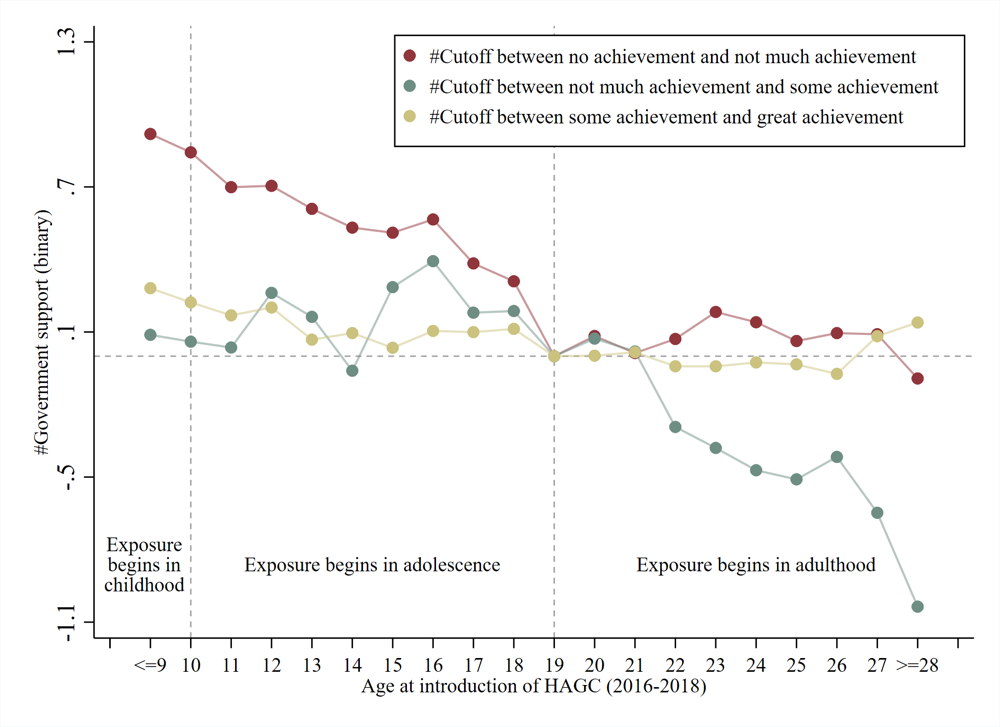
Estimated effects of television coverage across outcomes
Working paper Pre-PhD

The Legacy of Communist Dreams: Socialist Legacy, Automation, and Protest

with Siyuan Fan and Wenyi Lu

Presented at MPSA 2025, Chicago; RES 2025, Birmingham

View abstractClose abstract

Abstract

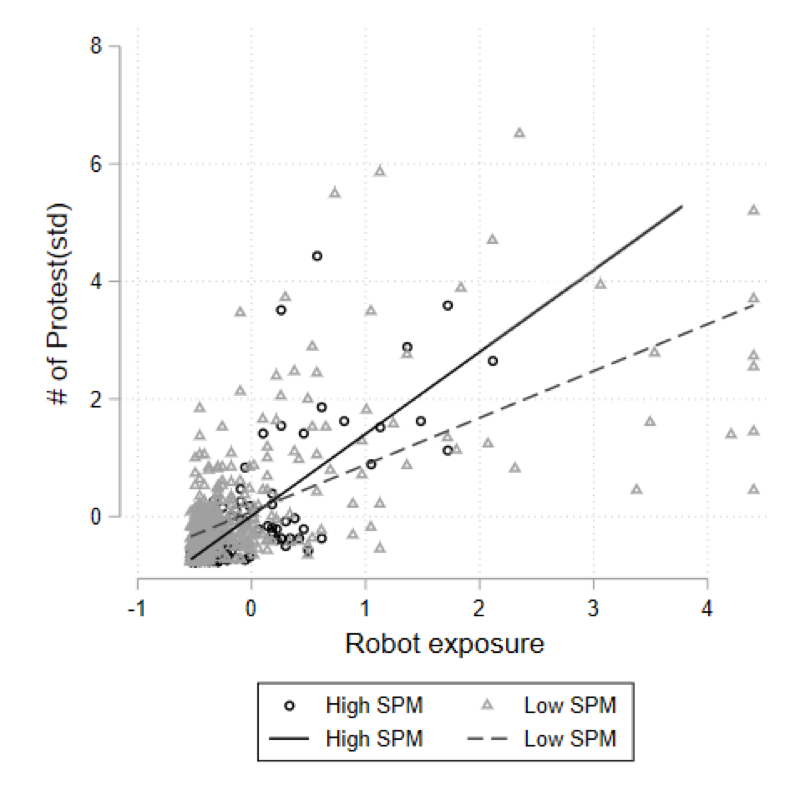
Why do revolutionary autocracies experience protests yet remain durable? This paper reconciles the paradox through the long-term political consequences of social revolutions. We propose legacy-conditioned targeting, in which mass mobilization and identity reconstruction generate a resistance-and-loyalty equilibrium. Citizens develop a strong inclination to resist unjust treatment alongside loyalty to revolutionary authority. These orientations persist through intergenerational transmission. Using original measures of China's socialist legacy and protest data from social media, we find that citizens protest when facing unemployment risk from automation, especially in areas with an intensive revolutionary legacy. The same legacy predicts stronger regime support and channels protest toward economic interests, consolidating the authoritarian status quo.

Spatial distribution of protests and socialist legacy
Working paper Pre-PhDM.Phil. Thesis

Manufacturing Enemies: Symbolic Policies and Social Conflict

View abstractClose abstract

Abstract

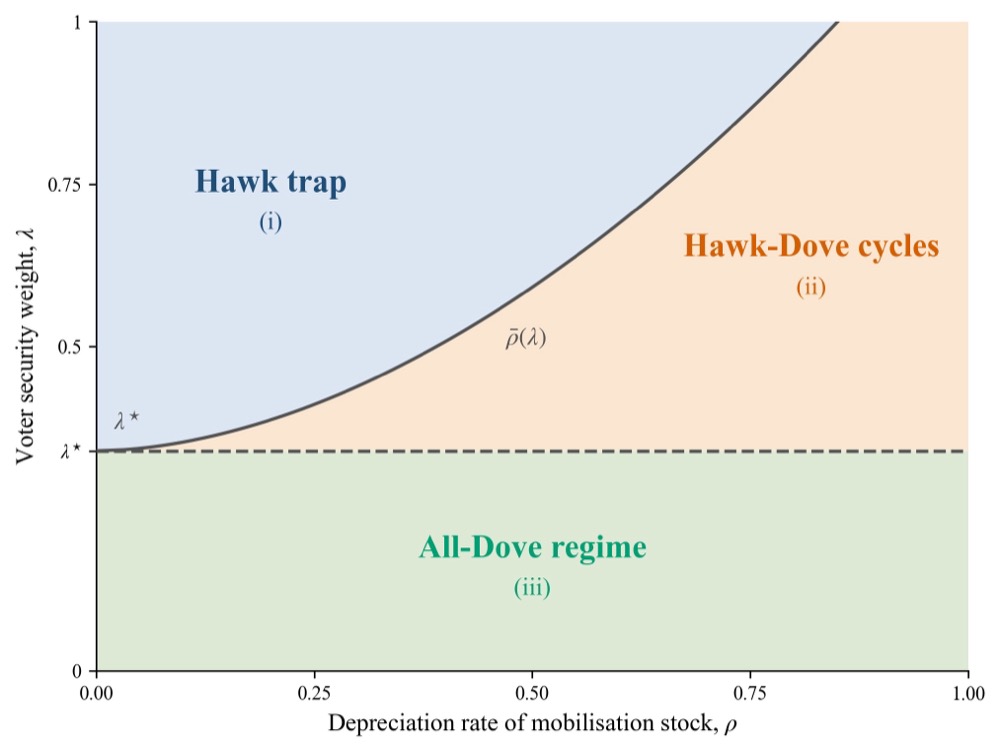
What is the purpose of identity-coded policies that target domestic minorities? I develop a theory of symbolic policies combining political competition and social conflict. Two parties compete in elections with probabilistic retrospective voting, while majority and minority groups contest identity security through costly individual effort. Symbolic policy allows a security-advantaged party to manufacture a threat that reduces majority free-riding and makes identity security electorally salient. A two-period model shows that the Hawk party's vote share is non-monotonic in the grievance it manufactures. Once minority mobilization becomes sufficiently strong, future conflict continues across incumbent policies. In the infinite-horizon model, the depreciation rate of minority mobilization determines whether politics enters a persistent Hawk trap or recurrent Hawk-Dove cycles. The predictions match patterns surrounding India's cattle-slaughter bans and clarify how restrictions on symbolic policy may backfire.

Phase diagram showing three political regimes in the model

Work in progress

  1. Technological Narratives
  2. SPDT: Superpower Dual-Use Technology
  3. Innovation-oriented Exams

Data projects

Data project Pre-PhD

Collective Action and Surveillance Expansion

with Zachary C. Steinert-Threlkeld and Han Zhang

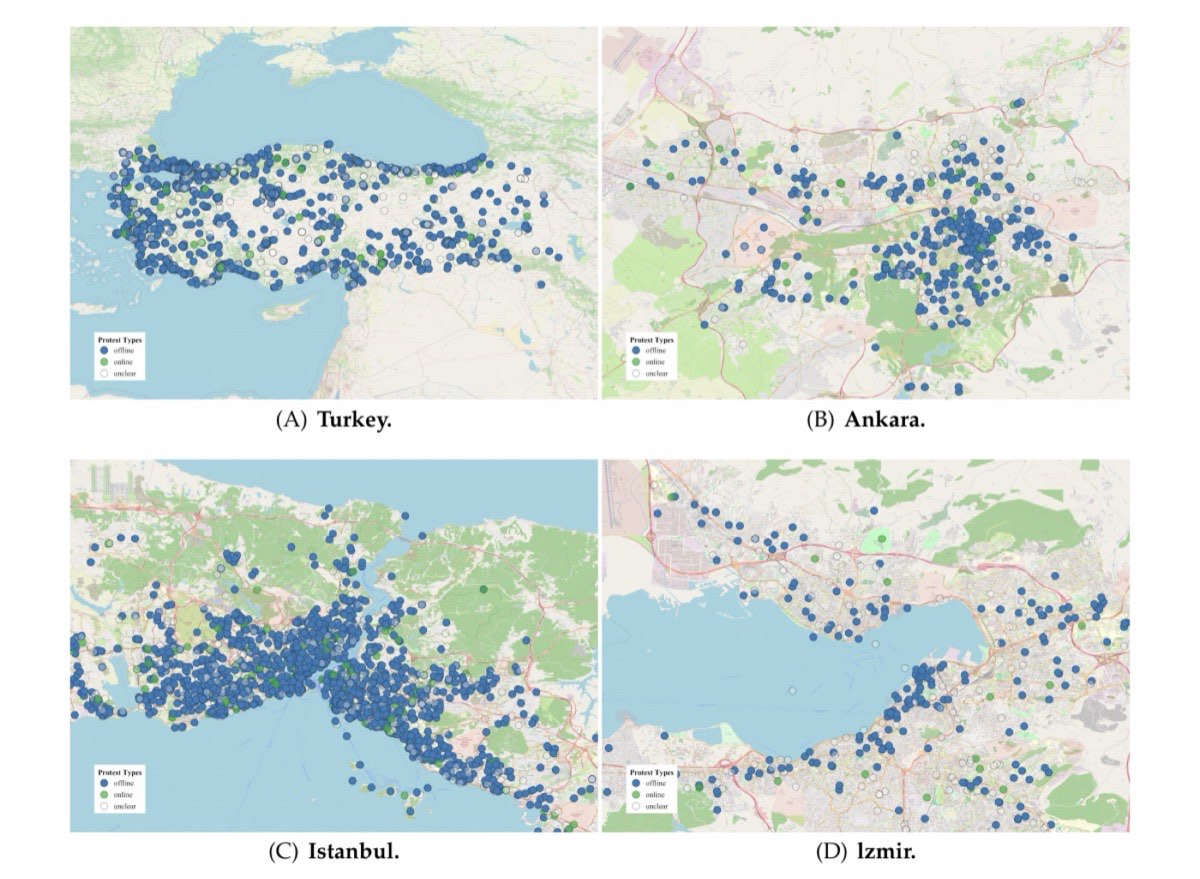
A new geospatial panel links offline protest events to local surveillance infrastructure across Turkey.

View project abstractClose project abstract

Abstract

How does collective action shape the expansion of state surveillance? We build a new geospatial panel linking offline protest events in Turkey to local camera infrastructure. Starting from 96.3 million geolocated Twitter posts collected between 2013 and 2020, a keyword filter, two-stage LLM classifier, human validation exercise, and spatiotemporal aggregation recover discrete protest episodes. The resulting daily series closely tracks an independent protest-event database during their common coverage period, with a Pearson correlation of 0.670. Around each protest location, we sample 50 road points within a 3 km x 3 km window, retrieve repeated Google Street View imagery, and apply computer vision to measure camera presence across locations and image vintages. The resulting location-time panel provides new data for studying whether contentious activity predicts subsequent surveillance deployment and how this relationship varies across urban space.

Maps of classified protest postings across Turkey, Ankara, Istanbul, and Izmir
Classified protest postings across Turkey and in Ankara, Istanbul, and Izmir.

Teaching

Reading groups

Since 2024, my coauthors and I have organized regular reading groups in political economy and microeconomic theory. We prepare lecture-style slides that synthesize research agendas and formal frameworks. Email me for the full reading lists.

Contact

Write to me at georgeht@mit.edu.